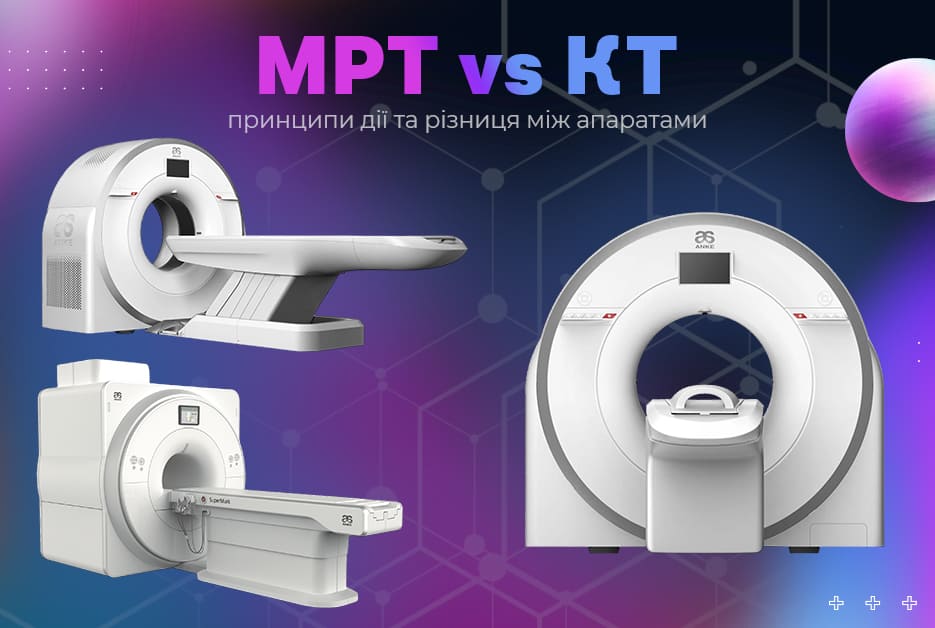
We regularly receive inquiries on the topic: "How to choose MRI or CT for a medical institution, what should be their power and how do they differ?" In modern medicine, both imaging methods are used to obtain detailed images of internal organs and tissues. In this article, we'll analyze the key differences between MRI and CT and help you decide which one best suits your needs.
What are MRI and CT?
Magnetic resonance imaging (MRI) uses strong magnetic fields and radio waves to create detailed images of soft tissues. Thanks to this technology, MRI is particularly useful for examining neurological conditions, joints and muscles. This allows doctors to obtain high-quality images without the use of ionizing radiation.
Computed tomography (CT), in turn, uses X-rays to create high-resolution images. This method is ideal for quick and accurate diagnosis of injuries, lung diseases and tumor detection.
"Slices" in CT scanners and what they affect
The number of slices in CT machines directly affects the quality and speed of scanning. A slice is an image obtained in one rotation of the X-ray tube, and the more slices, the more image detail can be obtained.
Multi-slice computed tomographs are 4-, 6-, 8-, 16-, 32-, 40-, 64- and 128-slice. A larger number of slices increases diagnostic possibilities and expands the range of applications, especially in cardiology.
- 2-, 4-, 6- and 8-slice CT scanners: Suitable for routine body examinations, performing multiple slices in one revolution in 0.8-0.5 seconds. They provide fast scanning and high image quality.
- 16-slice systems: suitable for basic examinations such as general examinations of the head, chest, abdomen. Reduced radiation load on the patient is one of the advantages.
- 32- and 40-slice tomographs: suitable for a variety of studies, offering improved image quality and clarity in anatomical detail.
- 64-slice systems: suitable for a wide range of diagnostic capabilities, including cardiovascular, oncology, and complex abdominal examinations.
- The 128-slice systems are ideal for rapidly scanning large numbers of slices in a short time, making them an excellent choice for highly specialized studies such as cardiology, neurosurgery, oncology and detailed vascular analyses.
When choosing a scanner, you should consider not only the number of slices, but also the area covered in one revolution. Multislice scanners will be especially useful for patients who have difficulty staying still for long periods of time, such as children or the elderly. The ideal number of slices is determined based on the specifics of health care services, types of studies, and demographic needs of patients.
What is the optimal power of the MRI machine?
When choosing an MRI machine, it is necessary to take into account the strength of the magnetic field, which is measured in tesla (T). This parameter reflects the level of the emitted magnetic field and depends on the magnet installed in the diagnostic unit. Next, we'll look at the different types of MRI scanners based on their power and their respective advantages and disadvantages.
- MRI scanners with a power of 0.5 T are suitable for basic diagnostic tasks and economic solutions. They guarantee sufficient image quality for many typical examinations, especially in small medical facilities, but low power results in longer scan times.
- MRI systems with a power of 1.5 T provide high quality images and are suitable for more complex diagnostic studies. These devices are ideal for large medical centers and specialized clinics where high resolution and accuracy are required.
- 3.0 T MRI machines provide high-detail images much faster, reducing overall procedure time. They are ideal for examining muscles, joints, blood vessels, nerves, small bones, brain, spine and heart.
Tomographs with a power of 1.5 Tesla are the optimal choice for clinical conditions, providing high image quality and processing speed. They are suitable for various diagnostic tasks, in particular examinations of the abdominal cavity and chest.
How to choose between an MRI machine and a CT scanner?
The choice between MRI and CT depends on specific medical tasks. MRI is an excellent choice for detailed examination of soft tissues, joints, and the nervous system, while CT is better suited for rapid diagnosis of injuries, lung disease, and tumor detection.
In our catalog you will find more detailed information about modern MRI machines and CT scanners. Our specialists will be happy to help you choose equipment, as well as answer all your questions. We also offer free testing and provide delivery to any corner of Ukraine.
With the Loran team, you can be sure of receiving detailed consultation and professional support at all stages of equipment selection.